Abstract
The main purpose of this study was examining the role of employees working environment on job performance of public sector specifically within newly established south Ethiopian region regional cluster offices located in arbaminch city, Ethiopia to address this issue the study focused on five variables that can measure the working environment and the study designed to employ explanatory research design with mixed research approach which gives the room to analyze the existing relationship of variables of study at study area through descriptive data analysis techniques utilized to categorize the data and derives meaningful understandings for reaching conclusions moreover, The researchers employed multistage sampling techniques to assure the representativeness of data drawing a sample of 173 employees from a population of 305, achieving a high response rate of 99.4% with 172 valid responses used for analysis. The findings indicated that the physical working environment, workload management, and training significantly increase employee performance On the other hand; rewards and having the option of work schedule did not show statistically significant effects on job performance also the Regression analysis reveals training of employees, physical working environment and actual workload strongly correlated with job performance, accordingly based on these results, the researchers recommended that regional offices management to constantly upgrading and optimizing the physical working environment to raise employee productivity and innovation in the study area and also Effective workload management is recommended to prevent overloading employees, thereby keeping their satisfaction and performance. Moreover, since employees responded positively to existing training schemes, the Public offices is encouraged to explore innovative approaches to training delivery to further enhance employee efficiency.
|
Published in
|
Journal of Human Resource Management (Volume 14, Issue 1)
|
|
DOI
|
10.11648/j.jhrm.20261401.15
|
|
Page(s)
|
48-59 |
|
Creative Commons
|

This is an Open Access article, distributed under the terms of the Creative Commons Attribution 4.0 International License (http://creativecommons.org/licenses/by/4.0/), which permits unrestricted use, distribution and reproduction in any medium or format, provided the original work is properly cited.
|
|
Copyright
|
Copyright © The Author(s), 2026. Published by Science Publishing Group
|
Keywords
Job, Performance, South Ethiopian, Regional Offices, Working Environment
1. Introduction
The efforts and the performance of the workforce are the soul and the heart of an organization since Performance of the employees greatly participates in the success of the organization linked with great difference can be happen with a minor change in the employees’ performance moreover, an exceptional performance leads to excellent performance of the organization this shows Crucial measures must be taken for meeting the end goals on the organization since employees’ behavior is influenced by the work environment that enhance the efficiency at the work environment
| [1] | Bushiri, C. P. The impact of working environment on employees’ performance. Asia Pacific Journal of Education. 2017, 3(1), 1–12. URL. |
[1]
. Moreover, the empirical study entitled “examining the effect of working environment in the job performance of employees in different part of the world” the study found All organizations have different sets of workforce working in their organizations, it would be logical to say employees’ performance can be the consequences of organizational performances and they are directly interlinked with each other as seen in the research
| [2] | Solomon, Y. Examining the effect of working environment on employee job performance. International Journal of Business and Management. |
[2]
.
However, the studies conducted in Ethiopian cases are still not adequate especially it is difficult to find the study conducted in public offices in Ethiopian regarding the working environment specifically in the setting of newly established and young regions that constrained to fulfill relevant work related equipment and services for workers. Therefore, this study aimed to address this gap by examining how the working environment influence the performance of employees at a job by focusing its attention on a southern Ethiopian regional state selected public offices of Arbaminch cluster.
Organizations for the sake of surviving and achieve its intended objectives needs to have highly professional and educated performers in its premises the same as organizations workers will also be satisfied by their working situation and proud of organizational culture. The study suggested that effective management of a firm's human resources plays a great role in developing and adding knowledge base, strengthen the cohesion among employees that can gear the performance as a tool for using advantage in competition as an organization
| [3] | Harter, J. K., Schmidt, F. L., Hayes, T. L. Business-unit-level relationship between employee satisfaction and performance. Journal of Applied Psychology. 2002, 87(2), 268–279. |
[3]
.
Even if, there is a bunch of study conducted across different countries in the world in Ethiopia, Most of government organization physical working environment is lacks a lot of elements required for safety of employee’s engagement. Some scholars argue that physical working place influence employee’s behavior in the workplace in case of both setting and its design
| [4] | McGuire, D., McLaren, L. The impact of physical work environment on employee commitment. Journal of Facilities Management. 2009, 7(3), 211–222. |
[4]
. Moreover, majority of governmental offices are inappropriately designed and there is insufficient ventilations, lack of office equipment’s like furniture, table, meeting hall, sufficient light access, sound system, shortage water facility and fully equipped rest room
| [5] | Kamarulzaman, N., et al. Influence of physical office environments on employees. Journal of Facilities Management. 2011, 9(3), 214–228. |
[5]
.
Employees in many organizations are encountering with working problems related to workplace environmental and physical factors the scholars has been argued that employee disengagement is increasing and it has become important to make workplaces that positively influence workforce
| [6] | Samson, G. N., Waiganjo, E., Koima, J. Workplace environment and employee engagement. International Journal of Human Resource Studies. 2015, 5(2), 1–12. |
[6]
.
Furthermore the scholars conducted empirical study entitled “Effect of Workplace Environment on Performance of Commercial Banks Employees in Nakuru Town” revealed that psychosocial aspects are an important factor in improving the performance of employees than the physical workplace factors and work life factors
| [7] | Ndung’u, J., Nyakundi, G. M., Njoroge, R. Workplace environment and employee performance. East African Journal of Education Studies. 2024, 7(3), 448–462. |
[7]
.
Hence, a lot of studies recommended the impact of work environment related problems on employee performance and it needs urgent response to address them for the sake of boosting organizational efficiency
| [6] | Samson, G. N., Waiganjo, E., Koima, J. Workplace environment and employee engagement. International Journal of Human Resource Studies. 2015, 5(2), 1–12. |
| [8] | Gu, Z., et al. Workplace environment and employee performance. Frontiers in Public Health. 2022, 10, 890400.
https://doi.org/10.3389/fpubh.2022.890400 |
| [9] | Myeya, P., Rupia, C. Working conditions and job performance. East African Journal of Education Studies. 2022, 5(2), 217–226. |
[6, 8, 9]
. However, the above study’s findings are not directly applicable to south Ethiopian regional state setup due to difference in type of industry, natural setting of the place, environment and system of administration and also most importantly methodological difference.
According to Tesfu (2019) study finding entitled “working environment factors effecting employee performance” the findings indicated that workload has insignificant negative effect on employee’s job performance
| [6] | Samson, G. N., Waiganjo, E., Koima, J. Workplace environment and employee engagement. International Journal of Human Resource Studies. 2015, 5(2), 1–12. |
| [8] | Gu, Z., et al. Workplace environment and employee performance. Frontiers in Public Health. 2022, 10, 890400.
https://doi.org/10.3389/fpubh.2022.890400 |
| [9] | Myeya, P., Rupia, C. Working conditions and job performance. East African Journal of Education Studies. 2022, 5(2), 217–226. |
[6, 8, 9]
. In light of this, this study motivated to explore the practical insight about topic at hand specifically which variables most influence both positively and negatively the working environment in relation with employee job performance
| [10] | Tesfu, A. Effect of working environment on employee performance. Addis Ababa University; 2019. |
[10]
.
Moreover, through informal communication with employees and management members of southern Ethiopian regional states employees they reflected many challenges that hinder the best performance of the employees in the study area including noise, entrance of inappropriate sun light to work place, lack of safe and comfortable workplace and unavailability of restrooms and others. This problem causes inefficient time management in the working time and directly leads to poor performance Based on researcher’s practical observation sometimes it is going to create conflict between directorates and employees. Since the establishment of southern Ethiopian regional state the employees transferred from their location Hawasa to Arbaminch but due to high temperature and inconvenient working place they are appealing for government during their first meeting with president of the region. Therefore, this research aimed to examine the effect of working environment on employee’s performance in newly organized southern Ethiopian regional states Arbaminch cluster offices.
2. Litrature Review
Job performance at Workplace of an organization can be disturbed by a lot of different factors that can be destruction for the employees and the Public offices. It is an open truth for Public offices to be successful and well established in the current drastic change of the world economy; it needs a high performing labor
| [11] | Creswell, J. W. Research Design. Sage; 2014. |
[11]
. As many as the factors are available, this research invested its attention on the factors mentioned below.
2.1. The Physical Working Environment
According to (Vischer, 2007), Physical work environment is defined as all physical conditions found around the workplace that can affect employees, both directly and indirectly
. She explained, the physical work environment is the whole or every aspect of physical and socio-cultural symptoms that surround or influence individuals. She categorized the physical working environment in to two groups namely environment that is directly related to employees, such as work centers, chairs, tables and so on and an intermediary environment or general environment which can also be called a work environment that affects human conditions such as temperature, humidity, air circulation, lighting, noise, mechanical vibration, odor, color, etc.
| [13] | Rahmi, T. E., Wibowo, S., Mukit, M. A. Physical work environment and performance. International Journal of Economics and Management. 2018, 12(2), 509–522. |
[13]
.
2.2. Work Load on Employees
ILO defined the pressure of work as the destructive responses both physical and emotional that is a result of discrepancy between what is actually perceived need and the available resources and abilities of the persons to fulfill those needs
| [14] | International Labour Organization. Workplace Stress: A Collective Challenge. ILO; 2016. |
[14]
.
Increased level of workload in employees has greater influence of stress level on the employees. In the year 2017 a survey conducted by (BUSHIRI C. P., 2017), showed 60% of the employees agreed upon the workload been increased over the past five years’ time. The most challenging task at work for the employees’ heavier workloads with competing deadlines were very difficult to around which was proved by about 25% respondents in the survey
| [1] | Bushiri, C. P. The impact of working environment on employees’ performance. Asia Pacific Journal of Education. 2017, 3(1), 1–12. URL. |
[1]
. The results were alarming, the aftermath of such situations should be realized on prior basis, to avoid key concerns of the employees’ issues and resolve them on immediate basis. Excessive workload comes with stress and exhaustion in an employee and it negatively influences their spirits, productivity, health, morale, and motivation level
| [15] | Al-Shammari, M. Job stress and productivity. Human Resource Development Review. 2015, 14(3), 334–356. |
[15]
.
2.3. Reward
The strategic vision and mission of an organization can be met by enabling employees to work towards achieving those goals by introducing a reward system that will make them productive and increase their job performance. The administration of reward in an organization is the design, execution and troubleshooting of reward procedures that are targeted towards the enhancement of the performance of the organization
| [16] | Pearce, J. A., Bangura, A., Kanu, J. M. Reward management systems. International Journal of Management Studies. 2019, 8(2), 101–115. |
[16]
. Understanding the issue of rewards and their management has becoming a critical point not only for scholars but also for parties associated with organization which are employer and employees.
It is also referring to all forms of financial returns and tangible services and benefits employees receive as part of an employment relationship
| [17] | Bratton, J. Reward management and performance. International Journal of Human Resource Management. 2010, 21(12), 2036–2053. |
[17]
.
2.4. Employee Training
Training is a formal, organized, and systematic modification of learning behavior having outcome as education, instructions, planned experiences and development
| [18] | Genzorová, T. Training and development. Human Resource Management Review. 2017, 27(2), 303–316. |
[18]
. The series of processes of the skills equipped, knowledge, attitude for handling responsibilities in an organization delivering these abilities to employees as referred as training. On contrary, developing is known as core competencies improving and grooming in employees for meeting future demands and to adapt to new environment and meet challenges (Ali, 2016).
To meet needs organizations, conduct frequent training and development programs. IT system, processes, procedures, management, technical skills are all part of training program. There are several types of training such as technical training might include specific to industry, it related training, training for supervisor, training for management, executive and compliance training, sales training, development training, customer skill training, services and quality training, business practices training
| [19] | Awan, A. G. Impact of training on employee performance. Journal of Economics and Sustainable Development. 2015, 6(8), 62–68. |
[19]
.
2.5. Working Schedule
In the last decades, the concept of working schedule has been brought to the focus of many schools of thoughts. The Working from Home concept was initially mentioned by Nilles (1988) dating back to 1973, known as “telecommuting” or “telework”
| [20] | Messenger, J. C., Gschwind, L. Three generations of telework. New Technology, Work and Employment. 2016, 31(3), 195–208. |
[20]
.
Working from home has been defined in various terms over the four decades, namely remote work, flexible workplace, telework, telecommuting, e–working. These terms refer to the ability of employees to work in flexible workplaces, especially at home, by using technology execute work duties. They described telecommuting as “an alternative work arrangement in which employees perform tasks elsewhere that are normally done in primary or central workplaces, for at least some portion of their work schedule, using electronic media to interact with others inside and outside the organization,” notably; they indicated that “elsewhere” refers to “home.”
| [21] | Gajendran, R. S., Harrison, D. A. Telecommuting and job outcomes. Journal of Applied Psychology. 2007, 92(6), 1524–1541. |
[21]
.
2.6. Conceptual Framework
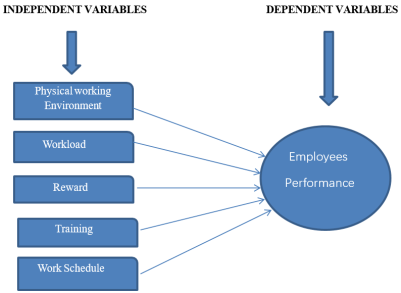
The following conceptual frame shows how independent variables relate with dependent variables and the ultimate goal of this frame is to indicate how the study was conducted and depict the major study variables. the variables of study was extracted from through reviewing of existing literatures and identified that employees working environment in the different organizations can be measured through Physical working Environment, Workload in the organization, organizational Rewarding system, delivering on job and off job Training and Work schedule were conceptualized as independent variables that has influence on Employee Job performance which is dependent variable.
Figure 1. Conceptual frame work of the study.
3. Research Methodology
3.1. Research Design and Approach
3.1.1. Research Design
The study employed both descriptive & explanatory research design because the descriptive design gives the researcher to understand what was the practical situation related to working environment in southern Ethiopian regional state arbaminch cluster and the explanatory research design preferred to capture the deep reason why the scenario happened in the study area finally, mixture of both design was best suited to grasp the actual influence of employee working environment on their job performance.
3.1.2. Research Approach
Time wise this study was employ Cross-sectional study with mixed research approach (Qualitative and Quantitative) because this mixed research approach better provide both numeric and non-numeric data about the study objectives. Quantitative approach based on measurement of amount which is applicable to express in terms of quantity and quantitative data provides precise summaries and comparisons, whereas the qualitative research method produces narrative or textual description of the phenomena under the study and provides general elaborations, explanation, meaning relatively new ideas.
3.2. Types and Sources of Data
In this study both qualitative and quantitative type of data were collected by using the primary and secondary sources of data in order to generate relevant information to the research.
3.2.1. Primary Source of Data
The study utilized key informants interview that guided by checklist and Structured questionnaire for the sake of collecting first hand data from study participants.
3.2.2. Secondary Source of Data
Secondary data was obtained by reviewing both published and unpublished sources were used after evaluating their relevance including books, articles, proclamations and journals, which provided the general and specific information about the various functions of the organizational working settings influence on employee job performance.
3.3. Target Population
The target population of the study was public sectors employees from selected four sectors based on the fact that high number of customers flows to these sectors. These selected regional offices were urban development and Construction Office, job creation and enterprises development office, justice and security office and Revenue and Custom office based on the preliminary data collected from the selected offices the total population of the study were 305 Accordingly the sample size was 173 respondents.
3.4. Sampling Technique and Sample Size Determination
3.4.1. Sampling Techniques
In this study, multi-stage sampling technique was employed to select the research participants. In the first stage, south Ethiopian regional state was selected purposively owing to researcher’s experiences and knowledge in the area. In the second stage, the study was conducted on purposively selected four (4) regional public service offices. The public service delivering sectors was selected purposively because of the magnitude and importance of institutions in serving the community and their relationship with diverse stakeholders or accommodating different stakeholders. Besides, these sectors are sectors of first grade service with highly skilled employees with high population of employees in the region. In the third stage, the sample sizes were divided in to each office by using the probability proportional size sampling. Finally, respondents were selected by using convenience sampling techniques from the sampling frame.
3.4.2. Sample Size Determination
After the regional offices identified, the sample of respondents will be determined by employing
| [22] | Yamane, T. Statistics: An Introductory Analysis. Harper & Row Publishers. 1967. URL: https://archive.org |
[22]
.
Where, n, implies sample size of the study population, N = implies the total population of the study and E = implies the precise of the confidence level (0.05).
4. Discussion
Measures of central tendency were used to analyze respondents’ perceptions, following the guidelines recommended in statistical analysis literature
.
Table 1. Mean value interpretation.
S/N | Mean score Range | Interpretation |
1 | Between 0.01 and 1.00 | Strongly disagree |
2 | From 1.01 To 2.00 | Disagree |
3 | From 2.01 To 3.00 | Neutral |
4 | From 3.01 To 4.00 | Agree |
5 | From 4.01 To 5.00 | Strongly Agree |
4.1. Descriptive statics of Physical Working Environment
Accordingly smaller value of standard deviation, considered as supportive for the argument or statement and vice versa. Regarding the report of analysis, the mean scores for the working environment parameters range from 3.90 to 4.31, this indicates that opinions of the respondents' are fairly consistent towards mean value. Thus, working environment parameters fall within the 4.169 to 4.314 range, indicating a strongly agreement, except for the parameter of comfortable, safe, and secure for carrying out work, which has a tend to agree response of mean 3.90.
Table 2. Items of Physical working environment.
No. | Statement | N | Mean | Standard Dev |
| Physical Working environment | | | |
1 | The workplace offers a quiet environment free from noise, allowing employee’s uninterrupted time to focus and concentrate. | 172 | 4.021 | 0.5221 |
2 | The physical environment is comfortable, safe, and secure for carrying out work. | 172 | 3.903 | 0.4787 |
3 | The environment has an appropriate amount of furniture and essential working equipment, such as stationery, computers, printers, tables, and chairs. | 172 | 4.072 | 0.5138 |
4 | The room has adequate lighting and enough windows to provide a view of the outside environment. | 172 | 4.314 | 0.5442 |
5 | The restrooms are clean and stocked with necessary supplies, such as water, soft paper, soap, and other essentials. | 172 | 4.246 | 0.5357 |
| The average Result 172 | | 4.169 | 0.4933 |
Source, Field survey data 2024
The average mean result 4.169 indicates the newly established Southern Ethiopian regional offices of arbaminch cluster has sufficient facilities including clean toilet at working area that sufficiently fulfilled necessary supplies, office furniture are provided for employees and employees get right amount of light in the offices.
According to key informants who participated in this study, following the creation of the new South Ethiopian region from the former SNNPR, office equipment and other relevant facilities were divided. Although many materials were damaged during transportation, the offices managed to provide basic working facilities, and employees did not face a shortage of office equipment.
4.2. Descriptive Statics of Work Physiology
Table 3. Mean response for work physiology statements.
No. | Statement | N | Mean | Stand. Dev |
Work physiology / Workload Management in the bureau | | | |
1 | The workload is distributed fairly among the employees in the bureau. | 172 | 4.2146 | 0.3981 |
2 | The amount of work assigned to me is manageable, allowing me to be free from work-related stress. | 172 | 4.0681 | 0.3648 |
3 | I have enough time for my family and friend after my work | 172 | 4.1894 | 0.3932 |
4 | I possess basic skills and capability to perform my job efficiently | 172 | 4.3042 | 0.3864 |
5 | Job-related responsibilities add to my workload in the bureau | 172 | 3.9878 | 0.3796 |
6 | I have time to take enough amount of break when I need | 172 | 4.1395 | 0.3869 |
Source, Field survey data 2024
As indicated Above Workload with mean score 4.1842 and standard deviation of 0.3887 tend to strongly agree with employees possess the required ability to run day to day activities of the organizations at the mean time they exercising sufficient break with conducive work environment that make employees free from any stress.
Key informants indicated that despite the management's efforts to fairly distribute tasks and jobs among staff members, the newly established offices encountered some issues. Due to the sharing of experienced experts, there was a performance capacity gap among the existing staff, making it challenging to handle both regular duties and tasks related to the country's reforms.
4.3. Descriptive Statics of Rewarding System of the Bureau
Table 4. Rewarding system of the bureau.
No. | Statement | N | Mean | Std. Dev |
1 | My salary reflects a fair and appropriate compensation considering my skills and responsibilities. | 172 | 3.814 | 0.4581 |
2 | My salary is sufficient to lead my life and satisfy my needs. | 172 | 3.867 | 0.4889 |
3 | The pay system is clear and well communicated. | 172 | 4.1681 | 0.4645 |
4 | I consistently receive praise from my supervisor and colleagues when I excel in my work. | 172 | 4.2342 | 0.4262 |
5 | Senior executives ensure that employees receive smooth processing of annual leave in accordance with public service rules and regulations. | 172 | 4.0984 | 0.4841 |
6 | My office have team building platform through on job, off job and retreat packages | 172 | 4.0768 | 0.4998 |
7 | I am always ready to accept any feedback about my job performance | 172 | 4.1264 | 0.4862 |
8 | My office rewards and recognizes the best-performing employees. | 172 | 4.0879 | 0.4988 |
| Average Result | 172 | 4.1121 | 0.4856 |
Source field survey data 2024
Regarding the rewarding practices in the selected public offices, a mean score of the respondents tends to strongly agree 4.112 indicates and a standard deviation of 0.4856 indicate that majority of employees response tend towards agree about receiving praise, and feedback. Rather than remaining neutral, they somewhat agree that the Public offices has a well-communicated remuneration system and clear annual leave policies. However, they moderately agree on the fairness of salaries in relation to their skills and responsibilities, and whether their salary is sufficient to meet their living needs. It can also be concluded that the public offices organizes effective team-building activities and various off-site retreat programs.
Key informants indicated that following changes among public service employees, dynamic evaluations have been taking place in southern Ethiopia. Employees are preparing themselves for upcoming competitions that focus on their capacity and potential for service delivery.
4.4. Descriptive Statics of Employee Training
Table 5. Statics of employee training.
No | Statement | N | Mean | Stad.Dev |
| Employees Training |
1 | My office conduct regular training need assessment to identify skill gaps of employees | 172 | 3.8482 | 0.5412 |
2 | My office provide sufficient training through on job platform for employees to enhance their skill | 172 | 4.1221 | 0.4938 |
3 | My office provide sufficient training through off job platform for employees to enhance their skill | 172 | 4.0892 | 0.5847 |
4 | The office provides training for employees by using off-the job training method. | 172 | 4.0122 | 0.5214 |
5 | My office has the culture of training evaluation after training provision | 172 | 3.7024 | 0.5532 |
| Average | 172 | 4.0372 | 0.5598 |
Source Field survey data 2024
The result provided in the table depicts that the average mean for Training, is 4.0372 tend to strongly agree response with stand.dev of 0.5598. This reveals the public service offices of south Ethiopia region have good training and development program that the employees really appreciate. But it shows that they have a little reservation on whether the offices conduct post training assessment.
Key informants noted that training employees both on the job and off the job was a budget- allocated activity for human resource development. However, they emphasized the need for a pre-assessment to identify gaps, rather than repeatedly providing training on similar topics. This current trend is seen as inefficient and a waste of time and budget.
4.5. Descriptive Statics of Work Schedule
Table 6. Statics of work schedule.
No | Statement | N | Mean | Stad.Dev |
| Work Schedule |
1 | Current working schedule of Arbaminch town better to be changed to utilize fork force effectively | 172 | 4.4682 | 0.4158 |
2 | I feel very comfortable working during before and after office hours. | 172 | 3.7587 | 0.4198 |
3 | I can work without disturbance from friends during before and after office hours. | 172 | 3.9879 | 0.4289 |
4 | I receive sufficient communication from my department heads during before and after office hours. | 172 | 3.8774 | 0.4324 |
| Average | 172 | 3.8241 | 0.4275 |
Source field survey data 2024
The descriptive statics result indicates that Work schedule with a mean of 3.8241 indicates agrees response and standard deviation of 0.4275 support that employees agreed for statements to change working schedule. But they show some reservation and are neutral about work before and after office time in consensus with their department heads and they are not worry about their family and the regional offices dedicated to fulfill required working materials.
Key informants also supported this view, revealing that currently, due to budget deficits and the need to build and maintain numerous regional infrastructures, most public resources are allocated to these priorities. However, they noted the strong commitment of the regional government to provide standardized working equipment and ensure that public sector jobs are considered decent work.
4.6. Descriptive Statics of Job Performance
Table 7. Statics of job performance responses.
No. | Statement | N | Mean | Std. Deviation |
1 | I am dedicated to meet preset deadline by concerning department heads | 172 | 4.1422 | 0.6013 |
2 | I have smooth communication with my immediate boss and co-workers | 172 | 4.0941 | 0.5891 |
3 | I always perform my duty in reasonable amount of time wit out missing tasks | 172 | 4.3132 | 0.5612 |
4 | I am present at work on a regular basis. | 172 | 3.8371 | 0.5984 |
5 | I will try to solve work related problems before reaching top excutives or section head. | 172 | 4.1946 | 0.6472 |
6 | Due to my satisfaction with my organization, I promote it to other people. | 172 | 3.6415 | 0.7467 |
7 | Always I utilize organizational resources efficiently and consequenitively improve culture of efficient use overtime | 172 | 4.3814 | 0.6012 |
8 | My section head gives me constructive feedback regularly. | 172 | 4.3217 | 0.7821 |
| Average Result | 172 | 4.2719 | 0.6594 |
Source field survey data, 2024
The result indicated above depicts that Job performance with a mean of 4.2719 tends to strongly agree and standard deviation of 0.6594 indicate that majority of employees generally agree they Meet deadline, effective communication, work is done in reasonable time, attempt to solve problem, using resource effectively and constructive feedback. Rather than remaining neutral, the employees present on work regular basis.
Key informants said that the employees are working to meet deadline of activities but they are not present regularly on the working place and the offices are losing a lot of senior employees due to non-compatibility of the environmental settings and ecology differences and the management of the offices tolerated the employees for semester but to lead the task according to expected work ethics they are forced to take administrative measure and a lot of employees are fired in this procedure.
4.7. Inferential Statics
Inferential statistics are used to draw conclusions from collected data to broader contexts, allows making generalizations about a larger population of study based on a sample. Various inferential statistical tests are available for different analyses and variables. They are closely linked to hypothesis testing, utilizing data to assess the validity of a hypothesis.
4.8. Correlation Analysis
Correlation refers to assessing the relationship between two or more numeric variables and determines whether there is a significant association between dependent and independent variables, measuring both the strength and direction of this relationship. The outcome of correlation analysis is expressed as a correlation coefficient, ranging from -1 to +1. A correlation coefficient of +1 indicates a perfect positive linear relationship between variables, while -1 indicates a perfect negative linear relationship. A correlation coefficient of zero signifies no linear relationship between the variables under investigation
| [24] | Gogtay, N. J., Thatte, U. M. Principles of correlation analysis. Journal of the Association of Physicians of India. 2017, 65(3), 78–81. URL: https://www.japi.org |
[24]
.
Table 8. Correlation result of variables.
S/N | Study Variables | PE | WL | RW | TR | WS | JP |
1 | Physical Environment (PE) | 1 | | | | | |
2 | Workload (WL) | .166* | 1 | | | | |
3 | Reward (RW) | .205* | .337** | 1 | | | |
4 | Training (TR) | .345** | 0.125 | .211* | 1 | | |
5 | Work Schedule (WS) | .377** | 0.124 | .377** | .370** | 1 | |
6 | Job Performance (JP) | .422** | .371** | .346** | .557** | .358** | 1 |
Source field survey data 2024
The table above depicts the correlation analysis results and accordingly the following conclusions were drawn. The results of Pearson correlation 0.557 and the significance level is 0.000, shows that existence of strong positive correlation between training and Employee Job Performance.
As depicted in the correlation work load and physical working environment with (coefficient value 0.371 and 0.422) respectively showed that there is moderate correlation with job performance of employee’s result but, Reward and Work Schedule has low correlation with job performance of employees with of 0.346 and 0.358 respective coefficient value but, Even if the correlation is low it is positive and significant predictor of job performance of employees in the study area which mean increase in reward shows increment in job performance of employees and the similar for work schedule in other word the southern Ethiopian regional offices provide required facilities for working from home the employees performance will be boosted.
4.9. Hypothesis Testing
In this section, the research tested the alternative hypothesis to determine the extent to which the predictor variable of study relates with explanatory variable of study.
Table 9. Hypothesis test result.
S/N | Formulated hypotheses | sig.(p-value) at 5% of significance level | Result |
1 | Ha1; Physical working environment has statically significant effect on employee job Performance | ß = 0.134, P = 0.008 | Accepted |
2 | Ha2; Work load has statically significant effect on employee job performance | ß = 0.233, P = 0.001 | Accepted |
3 | Ha3; Reward has statically significant effect on employee job performance | ß = 0.091, P = 0.100 | Rejected |
4 | Ha4; Training’s has statically significant effect on employee job performance | ß = 0.269, P = 0.000 | Accepted |
5 | Ha5; Work schedule has statically significant effect on employee job performance | ß = 0.055, P = 0.381 | Rejected |
Source analysis result, 2024
The result of hypothesis test shows that physical working environment is statically significant and positively related with Job Performance with ß
value and p-value (0.134, 0.008 respectively) which is under 0.05 this implies that a unit increase in physical working environment also increases, Job Performance by 0.135 with 5% significance level therefore, accepted the alternative hypothesis was accepted. This finding also supported by empirically study conducted by
Rahmi, Wibowo, & Mukit, (2018) that found physical working environment has positive influence on job performance | [25] | Rahmi, T. E., Wibowo, S., Mukit, M. A. Physical work environment and job performance. International Journal of Economics and Management. 2018, 12(2), 509–522. URL:
https://ijem.upm.edu.my |
[25]
.
Additionally, organizational performance management, “not only temperature, water quality, lighting and noise should be taken into consideration, but also the indoor air quality, thermal comfort, layout of individual workspaces and many other factors should be considered by the top management of organizations | [26] | Kamarulzaman, N., Saleh, A., Hashim, S. Physical office environment factors affecting employees’ performance. Journal of Facilities Management. 2011, 9(3), 214–228.
https://doi.org/10.1108/14725961111148113 |
[26]
.
Hypothesis 2 Ha2; Work load has statically significant effect on employee job performance
The regression result shows that workload has positively related with employee job performance with ß value and p-value (0.233 and 0.001) respectively which is under 0.05 this implies a unit increase in workload also increases job performance of employees by 0.233 with 5% significance level therefore, the alternative hypothesis was accepted.
The study revealed that focus on examining the effect of Workload on Employee job Performance revealed that workload has a positive and significant effect on Employee Performance which is highly consistent with this study finding | [27] | Situmorang, R., Hidayat, R. Effect of workload on employee performance. International Journal of Economics and Business Administration. 2019, 7(2), 187–198. URL:
https://www.iijbadmin.com |
[27]
.
Hypothesis 3 Ha3; Rewarding employee has statically significant effect on e job performance
The regression result depicts that rewarding the employees showed insignificant influence on employees job performance with ß value and p-value (0.091 and 0.100) respectively which is above 0.05 Therefore, alternative hypothesis was rejected and null hypothesis was accepted since reward has no significant effect on employee performance.
As depicted the correlation analysis the concrete reason is due to participant’s long service in minimum more than six year service coupled with new salary increment of regional government and having continuous monthly perdiem making them demotivated by rewarding.
The other means to reward employees that do not just focus on financial compensation. Some of these include recognition from their managers, the opportunity to take on important projects or tasks, and even leadership attention. The bases for reward distribution could be a reason that is inequity in the distribution of the available rewards and to whom it will be distributed. There may be little correlation between those who do great on their job and those who are chosen to receive the reward | [28] | Dewhurst, M. Motivating people beyond money. McKinsey Quarterly. 2010, 1, 12–15. URL: https://www.mckinsey.com |
| [29] | BCcampus. Reward systems and employee motivation. BCcampus Open Education. 2018. URL: https://opentextbc.ca |
[28, 29]
.
Hypothesis 4 Ha4; Training’s of employee has statically significant effect on employee job performance
The regression result of employee training shows it is positively related with job performance with ß value and p-value (0.269 and 0.00) respectively which is less than 0.05 and implies that a unit increment in employee training also increases, job performance by 0.269 with 5% significance level. Therefore, alternative hypothesis was accepted.
The empirical study conducted by Eunice Jane Amadi titled “The effect of training and development on employees’ performance at Safaricom limited call center” showed that the presence of strong relationship between employee performance and training of employees .
Hypothesis 5 Ha5; Work schedule has statically significant effect on employee job performance
The last hypothesis in this study was Work schedule and the regression result presented in the table above depicted that existence of positively connection between employee job performance with ß value and p-value (0.055 and 0.381) respectively which is more than 0.05 therefore, alternative hypothesis was rejected.
5. Conclusion
The researchers preferred to concluded according to its objective and study variables base as follows
1) The study found that physical working environment has positive correlation with organizational job performance of employees that can be related to factors such as security, comfort, adequate lighting, absence of noise disturbances, cleanliness of restrooms, and appropriate office furniture. Improving these physical aspects can potentially enhance employee performance.
2) Workload demonstrates a positive beta value in relation to employee job performance, which is statistically significant at a 5% significance level. Employees are generally satisfied with workload distribution and believe their skills are sufficient for handling assigned tasks. Organizing resources and balancing task assignments effectively can improve overall job performance.
3) While reward is positively associated with job performance, the regression analysis indicates that this relationship is statistically insignificant. This suggests that while rewards may have a positive impact on job performance, they do not significantly affect it.
4) Training has the most substantial effect on employee job performance, reflected in its high beta value of 0.269 and statistically significant correlation with job performance.
5) Increasing training opportunities for employees is likely to lead to significant improvements in job performance.
6) Working schedule shows a positive relationship with employee job performance, but the regression results reveal that this relationship is statistically insignificant. This indicates that while there is a positive association between work schedule and job performance, it does not significantly impact job performance.
In summary, while aspects like the physical environment, workload management, and training significantly influence employee job performance, rewards and working schedule do not show significant effects despite their positive associations.
6. Recommendation
Based on the analysis of this research and its findings, the following recommendations are proposed to enhance the working environment at south Ethiopian region regional offices:
Training Enhancement: The research highlights that training significantly improves employee job performance by boosting skills, productivity, and reducing turnover. It is recommended that the Public offices strengthen its training programs by enhancing methods, content, and timing of training sessions. Additionally, there should be a focus on evaluating training effectiveness systematically to maximize outcomes.
Physical Work Environment: The study confirms that a conducive physical work environment correlates strongly with employee performance. Comfortable workplaces promote productivity, creativity, and problem-solving abilities among employees. For instance, ample natural light, as noted by Leanne Thompson (2018), can enhance mood and productivity through increased vitamin D exposure. Therefore, it is recommended that study offices ensures workplaces are quiet, comfortable, safe, well-lit, and equipped with clean facilities to foster a positive atmosphere and support employee morale.
Rewarding system: The rewarding system of an organization expected to motivate the employees to work towards achieving preset organizational strategic goals those goals through updated a rewarding system that will make them productive and increase their job performance. Therefore south Ethiopian regional state public offices has to establish strong and well communicated rewarding system that motivates the whole employee for better accomplishment of tasks on the deadline and before deadline.
Effective Workload Management: Assigning appropriate tasks and responsibilities to employees plays a crucial role in reducing stress and enhancing performance. It is recommended that the Public offices implements fair workload distribution systems that allow employees to perform optimally without undue stress. Avoiding excessive workload ensures employees can deliver quality outputs within deadlines, thereby enhancing overall credibility.
Promotion of a Supportive Work Environment: Recognizing the impact of a supportive work environment on employee satisfaction and performance, it is recommended that regional offices foster an encouraging atmosphere where employees find joy in their work. Happy and loyal employees contribute significantly to the offices success by bringing innovative solutions and maintaining high productivity levels. Investing in initiatives that promote employee well-being and satisfaction will ultimately contribute to the institution's long-term success.
In essence, by prioritizing training effectiveness, optimizing the physical work environment, implementing fair workload management practices, and fostering a supportive workplace culture, south Ethiopian regional offices can enhance employee job performance and ensure sustained organizational success.
Abbreviations
SERS | Southern Ethiopian Regional State |
WS | Working Schedule |
ILO | International Labor Organization |
SPSS | Statically Package for Social Science |
SNNPR | South Nation’S Nationalities and Peoples Region |
Conflicts of Interest
There is no any conflict of interest.
References
| [1] |
Bushiri, C. P. The impact of working environment on employees’ performance. Asia Pacific Journal of Education. 2017, 3(1), 1–12. URL.
|
| [2] |
Solomon, Y. Examining the effect of working environment on employee job performance. International Journal of Business and Management.
|
| [3] |
Harter, J. K., Schmidt, F. L., Hayes, T. L. Business-unit-level relationship between employee satisfaction and performance. Journal of Applied Psychology. 2002, 87(2), 268–279.
|
| [4] |
McGuire, D., McLaren, L. The impact of physical work environment on employee commitment. Journal of Facilities Management. 2009, 7(3), 211–222.
|
| [5] |
Kamarulzaman, N., et al. Influence of physical office environments on employees. Journal of Facilities Management. 2011, 9(3), 214–228.
|
| [6] |
Samson, G. N., Waiganjo, E., Koima, J. Workplace environment and employee engagement. International Journal of Human Resource Studies. 2015, 5(2), 1–12.
|
| [7] |
Ndung’u, J., Nyakundi, G. M., Njoroge, R. Workplace environment and employee performance. East African Journal of Education Studies. 2024, 7(3), 448–462.
|
| [8] |
Gu, Z., et al. Workplace environment and employee performance. Frontiers in Public Health. 2022, 10, 890400.
https://doi.org/10.3389/fpubh.2022.890400
|
| [9] |
Myeya, P., Rupia, C. Working conditions and job performance. East African Journal of Education Studies. 2022, 5(2), 217–226.
|
| [10] |
Tesfu, A. Effect of working environment on employee performance. Addis Ababa University; 2019.
|
| [11] |
Creswell, J. W. Research Design. Sage; 2014.
|
| [12] |
Vischer, J. C. The effects of the physical environment on job performance. Journal of Environmental Psychology. 2007, 27(3), 175–184.
https://doi.org/10.1016/j.jenvp.2007.04.001
|
| [13] |
Rahmi, T. E., Wibowo, S., Mukit, M. A. Physical work environment and performance. International Journal of Economics and Management. 2018, 12(2), 509–522.
|
| [14] |
International Labour Organization. Workplace Stress: A Collective Challenge. ILO; 2016.
|
| [15] |
Al-Shammari, M. Job stress and productivity. Human Resource Development Review. 2015, 14(3), 334–356.
|
| [16] |
Pearce, J. A., Bangura, A., Kanu, J. M. Reward management systems. International Journal of Management Studies. 2019, 8(2), 101–115.
|
| [17] |
Bratton, J. Reward management and performance. International Journal of Human Resource Management. 2010, 21(12), 2036–2053.
|
| [18] |
Genzorová, T. Training and development. Human Resource Management Review. 2017, 27(2), 303–316.
|
| [19] |
Awan, A. G. Impact of training on employee performance. Journal of Economics and Sustainable Development. 2015, 6(8), 62–68.
|
| [20] |
Messenger, J. C., Gschwind, L. Three generations of telework. New Technology, Work and Employment. 2016, 31(3), 195–208.
|
| [21] |
Gajendran, R. S., Harrison, D. A. Telecommuting and job outcomes. Journal of Applied Psychology. 2007, 92(6), 1524–1541.
|
| [22] |
Yamane, T. Statistics: An Introductory Analysis. Harper & Row Publishers. 1967. URL:
https://archive.org
|
| [23] |
Bernstein, I. H., Nunnally, J. C. Psychometric Theory. McGraw-Hill. 1994. URL:
https://www.mheducation.com
|
| [24] |
Gogtay, N. J., Thatte, U. M. Principles of correlation analysis. Journal of the Association of Physicians of India. 2017, 65(3), 78–81. URL:
https://www.japi.org
|
| [25] |
Rahmi, T. E., Wibowo, S., Mukit, M. A. Physical work environment and job performance. International Journal of Economics and Management. 2018, 12(2), 509–522. URL:
https://ijem.upm.edu.my
|
| [26] |
Kamarulzaman, N., Saleh, A., Hashim, S. Physical office environment factors affecting employees’ performance. Journal of Facilities Management. 2011, 9(3), 214–228.
https://doi.org/10.1108/14725961111148113
|
| [27] |
Situmorang, R., Hidayat, R. Effect of workload on employee performance. International Journal of Economics and Business Administration. 2019, 7(2), 187–198. URL:
https://www.iijbadmin.com
|
| [28] |
Dewhurst, M. Motivating people beyond money. McKinsey Quarterly. 2010, 1, 12–15. URL:
https://www.mckinsey.com
|
| [29] |
BCcampus. Reward systems and employee motivation. BCcampus Open Education. 2018. URL:
https://opentextbc.ca
|
| [30] |
Amadi, E. J. Training and development and employee performance. International Journal of Human Resource Studies. 2014, 4(3), 1–12.
https://doi.org/10.5296/ijhrs.v4i3.6224
|
Cite This Article
-
APA Style
Ayza, S., Tirfe, A. (2026). Working Environment effect on Employee Job Performance: Evidence from Selected Regional Offices of Southern Ethiopian Regional State. Journal of Human Resource Management, 14(1), 48-59. https://doi.org/10.11648/j.jhrm.20261401.15
 Copy
|
Copy
|
 Download
ACS Style
Ayza, S.; Tirfe, A. Working Environment effect on Employee Job Performance: Evidence from Selected Regional Offices of Southern Ethiopian Regional State. J. Hum. Resour. Manag. 2026, 14(1), 48-59. doi: 10.11648/j.jhrm.20261401.15
Copy
|
Download
AMA Style
Ayza S, Tirfe A. Working Environment effect on Employee Job Performance: Evidence from Selected Regional Offices of Southern Ethiopian Regional State. J Hum Resour Manag. 2026;14(1):48-59. doi: 10.11648/j.jhrm.20261401.15
Copy
|
Download
-
@article{10.11648/j.jhrm.20261401.15,
  author = {Simegn Ayza and Abel Tirfe},
  title = {Working Environment effect on Employee Job Performance: Evidence from Selected Regional Offices of Southern Ethiopian Regional State},
  journal = {Journal of Human Resource Management},
  volume = {14},
  number = {1},
  pages = {48-59},
  doi = {10.11648/j.jhrm.20261401.15},
  url = {https://doi.org/10.11648/j.jhrm.20261401.15},
  eprint = {https://article.sciencepublishinggroup.com/pdf/10.11648.j.jhrm.20261401.15},
  abstract = {The main purpose of this study was examining the role of employees working environment on job performance of public sector specifically within newly established south Ethiopian region regional cluster offices located in arbaminch city, Ethiopia to address this issue the study focused on five variables that can measure the working environment and the study designed to employ explanatory research design with mixed research approach which gives the room to analyze the existing relationship of variables of study at study area through descriptive data analysis techniques utilized to categorize the data and derives meaningful understandings for reaching conclusions moreover, The researchers employed multistage sampling techniques to assure the representativeness of data drawing a sample of 173 employees from a population of 305, achieving a high response rate of 99.4% with 172 valid responses used for analysis. The findings indicated that the physical working environment, workload management, and training significantly increase employee performance On the other hand; rewards and having the option of work schedule did not show statistically significant effects on job performance also the Regression analysis reveals training of employees, physical working environment and actual workload strongly correlated with job performance, accordingly based on these results, the researchers recommended that regional offices management to constantly upgrading and optimizing the physical working environment to raise employee productivity and innovation in the study area and also Effective workload management is recommended to prevent overloading employees, thereby keeping their satisfaction and performance. Moreover, since employees responded positively to existing training schemes, the Public offices is encouraged to explore innovative approaches to training delivery to further enhance employee efficiency.},
 year = {2026}
}
Copy
|
Download
-
TY  - JOUR
T1  - Working Environment effect on Employee Job Performance: Evidence from Selected Regional Offices of Southern Ethiopian Regional State
AU  - Simegn Ayza
AU  - Abel Tirfe
Y1  - 2026/01/26
PY  - 2026
N1  - https://doi.org/10.11648/j.jhrm.20261401.15
DO  - 10.11648/j.jhrm.20261401.15
T2  - Journal of Human Resource Management
JF  - Journal of Human Resource Management
JO  - Journal of Human Resource Management
SP  - 48
EP  - 59
PB  - Science Publishing Group
SN  - 2331-0715
UR  - https://doi.org/10.11648/j.jhrm.20261401.15
AB  - The main purpose of this study was examining the role of employees working environment on job performance of public sector specifically within newly established south Ethiopian region regional cluster offices located in arbaminch city, Ethiopia to address this issue the study focused on five variables that can measure the working environment and the study designed to employ explanatory research design with mixed research approach which gives the room to analyze the existing relationship of variables of study at study area through descriptive data analysis techniques utilized to categorize the data and derives meaningful understandings for reaching conclusions moreover, The researchers employed multistage sampling techniques to assure the representativeness of data drawing a sample of 173 employees from a population of 305, achieving a high response rate of 99.4% with 172 valid responses used for analysis. The findings indicated that the physical working environment, workload management, and training significantly increase employee performance On the other hand; rewards and having the option of work schedule did not show statistically significant effects on job performance also the Regression analysis reveals training of employees, physical working environment and actual workload strongly correlated with job performance, accordingly based on these results, the researchers recommended that regional offices management to constantly upgrading and optimizing the physical working environment to raise employee productivity and innovation in the study area and also Effective workload management is recommended to prevent overloading employees, thereby keeping their satisfaction and performance. Moreover, since employees responded positively to existing training schemes, the Public offices is encouraged to explore innovative approaches to training delivery to further enhance employee efficiency.
VL  - 14
IS  - 1
ER  -
Copy
|
Download





 Share This Article
 Twitter
 Linked In
 Facebook